

New World Screwworm
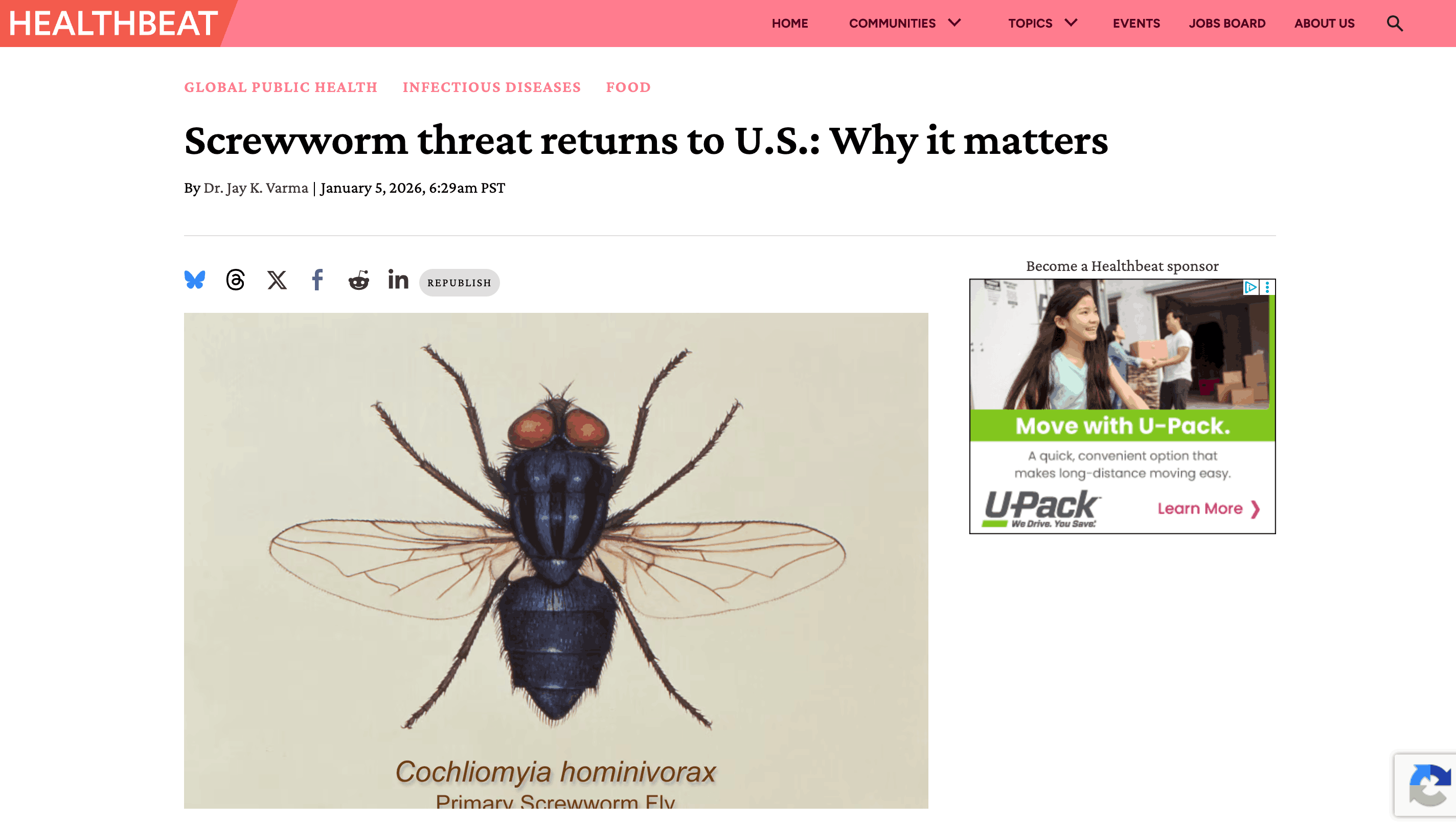
New World Screwworm (NWS) is caused by the larvae of a blowfly called Cochliomyia hominivorax. The larvae burrow into open wounds and feed on living tissue of warm-blooded animals, including livestock, pets, and sometimes people. NWS is not contagious and cannot spread from animal to animal, animal to person, or person to person.
NWS is an emerging public health concern and a serious threat to animal health, farming communities, and food security., especially in rural and border areas. The U.S. eradicated NWS in the 1960s using the sterile insect technique (SIT), but NWS has been spreading north through Central America and Mexico since 2023.
On June 3, 2026, USDA-APHIS confirmed the first animal case in the continental U.S. in a cow in Zavala County, Texas prompting CDC to activate its Emergency Operations Center. A comparable outbreak could cost the U.S. Southwest more than $3 billion. The U.S. eradicated NWS in the 1960s through the Commission for the Eradication and Prevention of Screwworm (COPEG), a binational partnership with Panama that USDA estimates saves the U.S. cattle industry $2.3 billion a year.
Farmworkers in South Texas and border regions face the highest risk. About 75% of U.S. farmworkers are Latino migrants, many working outdoors without healthcare, job protections, or information in their language and facing real barriers to reporting and receiving care.
As of July 2026, NWS has been confirmed in Texas and New Mexico. CDC and USDA are jointly coordinating a One Health response. No human cases have been acquired locally in the U.S., though a travel-associated case occurred in Maryland in August 2025 in a person returning from El Salvador. The government has authorized FDA emergency use authorizations (EUAs) for animal treatment drugs and is deploying SIT. Warming temperatures are expanding where NWS can survive, making ongoing monitoring essential.
Border and rural communities in South Texas who are already underserved are the hardest hit. Nearly 2,000 USDA APHIS employees have left since January 2025, weakening disease monitoring where it is needed most. Additionally, $382 million was cut from the UN Food and Agriculture Organization, which had previously supported eradication efforts in Central America. Language barriers and immigration fears reduce access to information and care in the region.
NWS is a reportable foreign animal disease; all suspected animal cases must be reported to USDA APHIS. Providers should watch for NWS symptoms (worsening wounds with larvae or foul odor) in patients with recent travel to Central America, Mexico, South America, Cuba, Haiti, or the Dominican Republic. CDC clinical guidance is available. The U.S. food supply is safe NWS does not infest meat or food.
The return of NWS shows that public health does not stop at borders. When workforces are cut, partnerships defunded, and climate change shifts disease ranges, threats we thought were gone come back and often disproportionately affect communities least able to respond. The One Health framework which treats human, animal, and environmental health as one system, is essential here. Addressing NWS at scale means rebuilding USDA APHIS workforce capacity, reinvesting in COPEG, using climate-informed risk models, and delivering multilingual communications to farmworker and border communities. Maintaining backup SIT production ensures eradication tools stay available.
Community health workers, promotors, and farmworker advocates are trusted messengers who can share clear, culturally appropriate information on wound care, symptoms, and reporting. Groups like Farmworker Justice and the Migrant Clinicians Network offer proven community-centered models. Locally, communities can push for better protective gear, stronger worker protections, and faster reporting pipelines. Training veterinarians, ranchers, and public health workers together is key early detection is the most powerful tool we have.
Resources & Tools

Related Topics
